Palletizers for palletless goods flow
High-performance processes for effective intralogistics
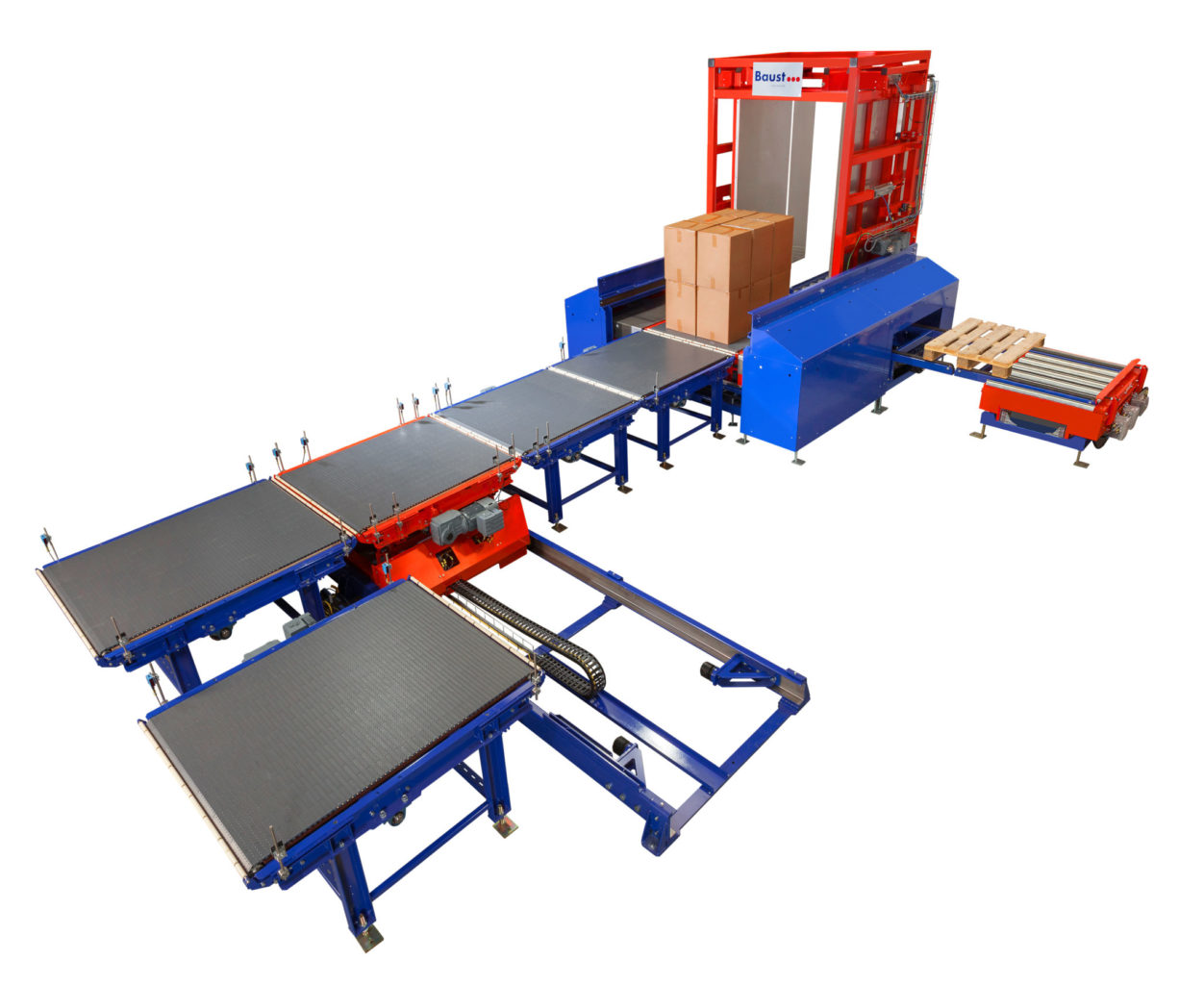
When intralogistics requires palletless receiving, transport, or shipping of goods, Baust's high-performance palletizers offer the key technology. Particularly in outbound logistics for international shipments in overseas containers, eliminating pallets allows for enormous savings in transport volume and pallet costs . The systems automatically unload any load from the pallets – significantly faster, safer, and more cost-effective than manual or robot-assisted packing. In addition to the push-pull method, clamping or pulling methods are used depending on the pallet and load. Typical applications include automated conveyor systems and high-throughput storage systems in the food, pharmaceutical, logistics, cosmetics, and chemical industries, as well as in mechanical engineering.
Your advantages with Baust palletizers:
- Palletless export shipping saves transport volume and pallet costs.
- Avoiding problems caused by wooden pallets: dirt, inspection, maintenance/repair, replacement, downtime, malfunctions
- Maximum customization to your requirements with the following methods: pushing, clamping and pulling
- Use of inexpensive and space-saving slipsheets for push-pull forklift attachments instead of pallets
- Up to 5 times faster than systems that handle containers layer by layer or piece by piece.


Fully automated palletizing with Baust (palletizing system)
Technical information
- Performance: 60 – 80 cycles/h
- Operating mode: Automatic control
- Loading & unloading: Forklifts/conveyor technology
- Rear and side walls: pneumatically adjustable
- Power supply: 4 kVA – 16A 230/400 V R1/2”, 6 bar
- Dimensions (L x W x H in mm): 3600 x 3000 x 3150
- Machine weight: approx. 3200 kg
Pallet loading
- Total weight up to 1200 kg
- Standard pallet (W x L in mm): 800 – 1000 x 1200
- Max. height including pallet: 2000 mm
- Goods: e.g. cardboard boxes, barrels, crates, big bags, sacks or bottles
- Overload tolerance per side: 50 mm
options
- Slipsheets: Palletizing onto wooden pallets or depalletizing onto slipsheets
- Slipsheet or Cover overlays and collectors
- Contact parts with stainless steel charge
- Product height > 2000 mm
- Automatic pallet magazines
High-speed palletizing (automatic palletizing) by palletizers
The palletizing process using a push method begins with the insertion of the loaded pallet. The rear and side walls of the palletizer close and conform to the load. The entire load is then gently, quickly, and safely pushed from the pallet onto the slightly lower destination conveyor.
In conventional palletizing systems, this process only occurs layer by layer or even piece by piece. Further transport of the load now takes place without pallets on link belt or special roller conveyors. The empty pallet is ejected directly from the side of the palletizer and can be stacked in a pallet magazine. This is what an efficient palletizing process with up to 80 cycles per hour looks like. The palletizing process itself runs in reverse.
The clamping and pulling palletizers complete Baust's product range and are also based on handling the entire load stack in one cycle step.
Request a non-binding quote for palletizing now
Efficiency in outbound logistics: what a palletizer saves
Every pallet that doesn't travel to its overseas destination reduces freight and procurement costs. An automated palletizer simultaneously relieves the team of the heavy lifting of restacking and maintains a consistent pace even during the third shift. Instead of palletizing containers by hand, the system takes over the cycle to precisely and repeatably place each load onto a slipsheet or pallet.
Precision pays off twice over when palletizing. Accurately placed loads arrive less frequently damaged, which significantly reduces complaints and rework, making shipping more efficient.
Cartons, bags and trays in the same cycle
Our palletizing technology allows for flexible adaptation to various packaging materials, whether cartons, bags, or trays. Because the entire stack is moved in one go, the shape of the individual package is less critical than with layer-by-layer systems. The system compensates for overloads of up to 50 mm on each side, and the contact parts with the load are made of stainless steel.
For a reliable assessment, we only need your throughput, pallet type, and hall layout . Contact us, and we'll calculate the cycle time for your line.
Automated palletizers for consistent process quality
An automated palletizer offers more than just reduced manual labor. Above all, it makes output predictable because every cycle is identical. Once set up, the palletizer operates automatically, even across shift boundaries. Our systems integrate seamlessly into the production flow without requiring any modifications to the existing palletizing system .
Modern sensor technology detects different product formats and adjusts the system accordingly. This increases manufacturing flexibility while simultaneously reducing the risk of workplace accidents when handling heavy loads . A magazine for intermediate layers and automatic feeding ensure robust operation, even with frequent product changes.
Because design and manufacturing are located in the same building, we tailor the gripping range, cycle time, and control system to your line during the planning phase , instead of retrofitting a catalog model. This makes automation reliably reproducible.
Compact and modular systems grow with the operation
Automation is no longer just worthwhile for large production runs. A compact palletizer can also fit into existing halls and process multiple pallet formats without requiring you to rebuild the line.
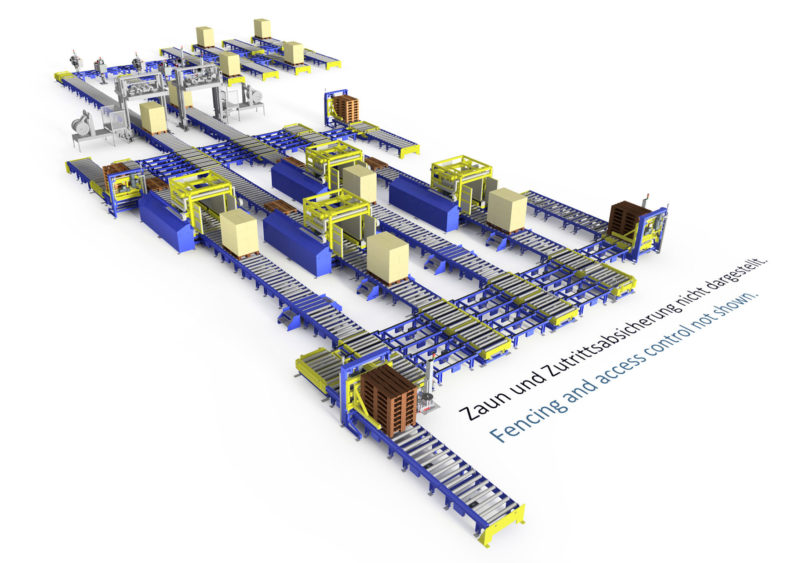
The decisive factor is not so much the footprint, but rather which types of containers are processed together. As the operation grows, a modular palletizer can be expanded later: additional stations, an empty pallet magazine, or a second infeed can be added. Larger plants can thus connect several palletizers to palletizing systems that handle the entire outbound process.
Where personnel are already working on the production line, a smaller system is often sufficient: operators load the pallets, and the system handles the transfer. Semi-automatic palletizers pay for themselves particularly quickly in such situations. Ultimately, the economically viable palletizing solution depends on the number of units per shift and the required flexibility, not the company size. Even a single-shift operation will justify the cost of a system if several hundred pallets are processed daily.
How a palletizer improves your production line
The goods flow directly from the conveyor belt into the system, eliminating any backlogs at the outbound point. The efficiency of the entire line often hinges on this single transfer. Especially in areas where manual handling was previously required, the bottleneck that dictated the pace of entire production lines disappears.
Intelligent control systems integrate the system with your process control technology. Short changeover times allow for format changes without lengthy line downtime. As soon as a stack is palletized, it goes directly to shipping, accelerating logistics processes throughout the entire outbound logistics process.
Contact us for an analysis of your production requirements.
Integration into your logistics processes and existing conveyor technology
New technology must integrate seamlessly into existing systems without interrupting ongoing production. To achieve this, our technicians first analyze the interfaces, cycle times, and control levels of the existing palletizing and conveying technology, and then design the connection accordingly. Our in-house automation team handles the electrical design, visualization, and PLC programming. Thanks to the modular design, individual automation components can be replaced during maintenance.
We have developed flexible interfaces that allow a modular palletizer to communicate with conveyor belts, pallet conveying systems , and higher-level systems. The conversion is carried out gradually during ongoing operations, enabling you to automate your outbound processes step by step. If you want to build the entire chain from a single plan, our complete systems offer conveying, changing, packaging, and disinfection in a seamless concept.