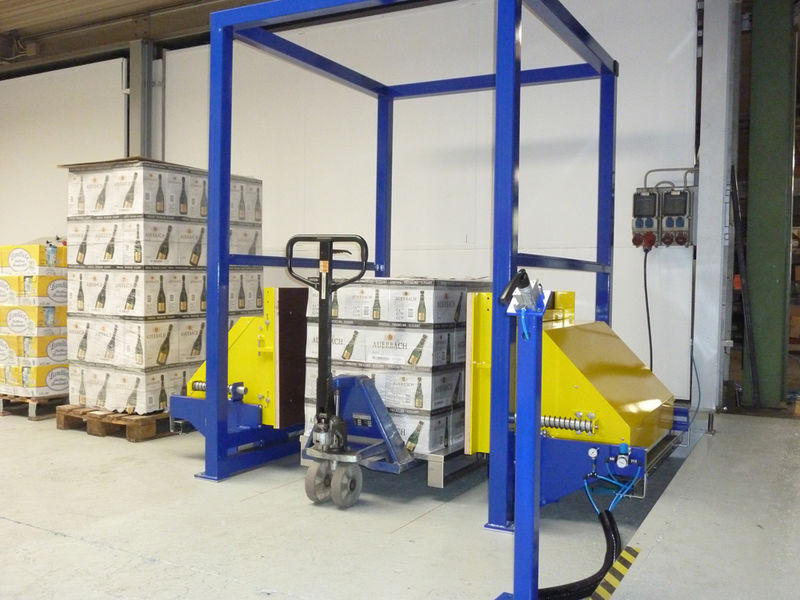
Not every repalletizing method is suitable for every type of load. Whether sensitive pharmaceutical products, heavy beverage crates, or unstable bagged goods: choosing the right method is crucial for throughput, product protection, and cost-effectiveness.
Which pallet changeover method suits your requirements?
Choosing the right pallet changing method has a direct impact on the efficiency of your material flow. Baust Pallet Handling GmbH has been developing and manufacturing pallet changers for a wide range of industries and requirements for over six decades. During this time, it has become clear that the decision between clamping, rotary-tilting, transfer, and hybrid solutions depends on several factors. This article explains the four common pallet changing methods, compares their strengths and areas of application, and helps you find the optimal solution for your production.
Why choosing the right pallet changing method is crucial
Impact on throughput and efficiency
In many production and logistics companies, pallet changing is part of the daily routine. Wooden pallets are exchanged for hygienic pallets, damaged load carriers are replaced, or industry-specific pallet formats are used. The pallet changing method selected has a significant impact on how many changes per hour are possible and how smoothly the process integrates into existing material flow lines.
A method that is too slow slows down the entire material flow. Conversely, a method that is too aggressive can damage sensitive goods. Depending on the method, the cycle time of a pallet changer is between 50 and 60 changes per hour. Which value is relevant for your operation depends on the cycle times of upstream and downstream processes.
Load protection as a key selection criterion
In addition to speed, load protection plays a decisive role in the choice of method. Not every product can withstand clamping pressure, rotation, or tilting. Pharmaceutical goods on hygiene pallets require different methods than stable beverage crates or big bags. Making the wrong choice here risks product damage, complaints, and downtime. From our experience spanning more than six decades, we know that a careful analysis of the load is the first step toward efficient palletizing.
How the clamping process works
Design and operating principle
In the clamping process, the palletized stack is secured by two opposing side walls. The clamping plates grip the load from the side and hold it securely in position while the source pallet is lowered and removed. A new target pallet is then inserted and the stack is placed on it. The entire process takes only a few seconds.
The clamping force can be continuously adjusted to the respective load. Modern clamping pallet changers such as the PW 500 are equipped with non-marking pads that gently hold even packaged goods. The process achieves up to 50 changes per hour and is suitable for both stationary and inline configurations.
Typical areas of application and suitable loads
The clamping method is particularly suitable for dimensionally stable, firmly packed goods. Cardboard boxes, beverage crates, mesh boxes, and shrink-wrapped stacks can be reliably repalletized using this method. Due to its comparatively simple mechanical design, the clamping method offers an economical entry into automated repalletizing. However, it is less suitable for pressure-sensitive or unstable loads.
The turn-and-tip method and its strengths
How the 180° rotation works
In the turn-and-tip method, the palletized stack is secured on three sides and then rotated 180 degrees. After rotation, the original pallet is on top and can be easily removed. A new pallet is inserted and the stack is rotated back. The result is a complete pallet change in which the load retains its order and layering.
Pallet turners based on the turn-and-tip method can achieve up to 55 changes per hour. The three-sided fixation ensures a secure hold even with less stable loads. In contrast to the clamping method, the goods are not only held from the side, but also from above and below.
For which goods is the rotate-tilt method suitable?
The rotate-tilt method is particularly suitable for loads that are less dimensionally stable but can withstand rotation. Bagged goods, barrels, big bags, and goods with lateral overhang can be reliably repalletized using this method. The turn-and-tip method is also the right choice if the entire load needs to be turned, for example to make the underside of the load accessible.
Push-over method for sensitive loads
Gentle pallet change without tipping or turning
The transfer method completely eliminates rotation, tilting, and clamping pressure. Instead, the load is pushed horizontally from the source pallet to the target pallet. A slider glides between the pallet and the load, while the new pallet is inserted from the opposite side at the same time. The load remains in its exact position and is never lifted or rotated.
With up to 60 changes per hour, the transfer method is the fastest of the four pallet changing methods. Pallet changers in the PW 1000 to 6000 series work according to this principle and cover different load sizes and weight classes. Despite the high speed, the stress on the load remains minimal.

Use in the pharmaceutical and food industries
The transfer method is the preferred method in the pharmaceutical industry and food production. Here, wooden pallets must be replaced with plastic or metal pallets for hygienic reasons without damaging or contaminating the product. In combination with clean room locks, the process meets the most stringent GMP and HACCP requirements. Transfer is also the safest solution for pressure-sensitive packaging, stacked cans, or loosely layered goods.
Hybrid pallet changers combine several methods
How does the combination of different methods work?
A hybrid pallet changer combines two or more pallet changing processes in a single machine. For example, the gentle transfer process can be combined with the powerful clamping process. Depending on the load, the operator or the control system automatically selects the appropriate process. The changeover takes place without mechanical conversion and without interrupting the material flow.
This flexibility was developed by our engineering department to offer companies with changing loads an economical alternative to multiple individual machines. A hybrid system covers various requirements while reducing the space required in production. The control technology recognizes which load is being fed and adjusts the method accordingly.
When is a hybrid system worthwhile?
A hybrid pallet changer is particularly economical if different loads are regularly repalletized in your operation. Instead of purchasing two or three complete systems for different processes, a hybrid system performs the tasks flexibly in a minimum of space. This saves investment costs, reduces maintenance requirements, and greatly simplifies production planning.

Pallet changeover methods in direct comparison
The four pallet changeover methods differ significantly in terms of speed, suitability, and space requirements. The following table summarizes the most important characteristics and provides you with an initial guide to help you choose the right method.
| Criterion | Clamping Method | Tilt-Turn Method | Push-Over Method | Hybrid |
|---|---|---|---|---|
| Speed | up to 50 changes/hr | up to 55 changes/hr | up to 60 changes/hr | method-dependent |
| Product protection | medium | medium | very high | high |
| Suitable load types | dimensionally stable, packaged | bagged goods, drums, big bags | pressure-sensitive, unstable | varying goods |
| Space requirement | low | medium | low to medium | medium |
| Inline capability | yes | yes | yes | yes |
| Investment (relative) | low | medium | medium to high | high |
| Flexibility | low | medium | low | very high |
No single method is universally better than another. The decisive factors are the combination of load, cycle requirements, and industry regulations. A company that exclusively handles dimensionally stable cardboard boxes will achieve its goals economically with the clamping method. On the other hand, a company that repalletizes bags today and sensitive pharmaceutical products tomorrow will benefit from a hybrid solution.
When evaluating the options, also consider inline capability. All four methods can be integrated into existing conveyor lines. The decision between stationary or inline primarily depends on the throughput and the layout of your material flow.
Which method is suitable for which industry?
Pharmaceutical and food industry
Strict hygiene regulations apply in the pharmaceutical and food industries. Wooden pallets are often not allowed to enter clean rooms and production areas. The transfer method is the first choice here, as it performs pallet changes without pressure, rotation, or vibration. In conjunction with disinfection locks and clean room locks, this creates a seamless hygiene process from goods receipt to the production line.
Automotive and chemical industries
Stable KLT containers and standardized load carriers dominate the automotive industry. The clamping method or a hybrid system offers the necessary throughput while remaining easy to operate. In the chemical industry, barrels are often moved on CP pallets. The turn-and-tip method is particularly suitable for these heavy, cylindrical loads, as it securely fixes the load on three sides.
Logistics centers and distribution
Logistics centers face the challenge of repalletizing a wide variety of loads every day. Cartons, bags, shrink-wrapped bundles, and display pallets alternate. A hybrid pallet changer offers the greatest flexibility in this environment. Alternatively, many distribution warehouses rely on the transfer method, as it covers the widest range of loads at the highest speed.
The most important selection criteria for your process
Load and type of packaging
The load is the key decision criterion when choosing a pallet changing process. Clarify the following points before deciding on a solution:
- Is the load dimensionally stable or pressure-sensitive?
- Can it withstand lateral clamping pressure?
- Can it be rotated without being damaged?
- What pallet format is being loaded and unloaded?
These four questions already significantly narrow down the possible methods. Pressure-sensitive goods rule out the clamping method. Liquids in open containers rule out the rotary-tilting method. Dimensionally stable standard goods, on the other hand, give you a free choice.
Throughput, space requirements, and degree of automation
Throughput and space requirements are equally important. Do you need 30 or 60 changes per hour? Is the pallet changer stationary or integrated into a conveyor line? The desired degree of automation also plays a role. From manually operated clamp changers to fully automatic inline systems with PLC control, every gradation is possible. If you are unsure which method is right for your application, take advantage of our free initial consultation. A joint analysis of your material flow will lead to the right solution.
Frequently asked questions about pallet changing methods
How much does a pallet changer cost?
The costs depend on the selected method, the level of automation, and the individual configuration. A simple clamp changer is in a different investment range than a fully automatic inline pallet changer using the transfer method. It is therefore not possible to make a blanket statement. Individual project planning will provide you with reliable figures for your planning.
Which method is the fastest?
The transfer method achieves the highest throughput among pallet changing methods, with up to 60 changes per hour. The rotate-and-tip method follows with up to 55 changes, and the clamping method with up to 50 changes per hour. The actual performance also depends on the load, pallet format, and feed.
Is it possible to switch between methods?
Yes, with a hybrid pallet changer. These systems combine two or more methods and enable changing via control without mechanical conversion. This allows different loads to be repalletized on a single machine without interrupting the material flow.
What is the difference between a pallet changer and a pallet turner?
A pallet changer replaces the pallet under the load without turning the goods themselves. A pallet turner rotates the entire stack 180 degrees, for example to make the underside of the load accessible. The turn-and-tip method can perform both functions, as it rotates the stack and enables pallet replacement at the same time.
Conclusion
The choice of the right pallet changing method always depends on your specific application. Dimensionally stable goods can be efficiently repalletized using the clamping method. Bagged goods and barrels require the turn-and-tip method. Sensitive products in the pharmaceutical and food industries benefit from the gentle transfer method. And if your company works with changing loads, a hybrid pallet changer combines the strengths of several methods in one system. We support you in analyzing your material flow and work with you to find the solution that exactly fits your requirements.