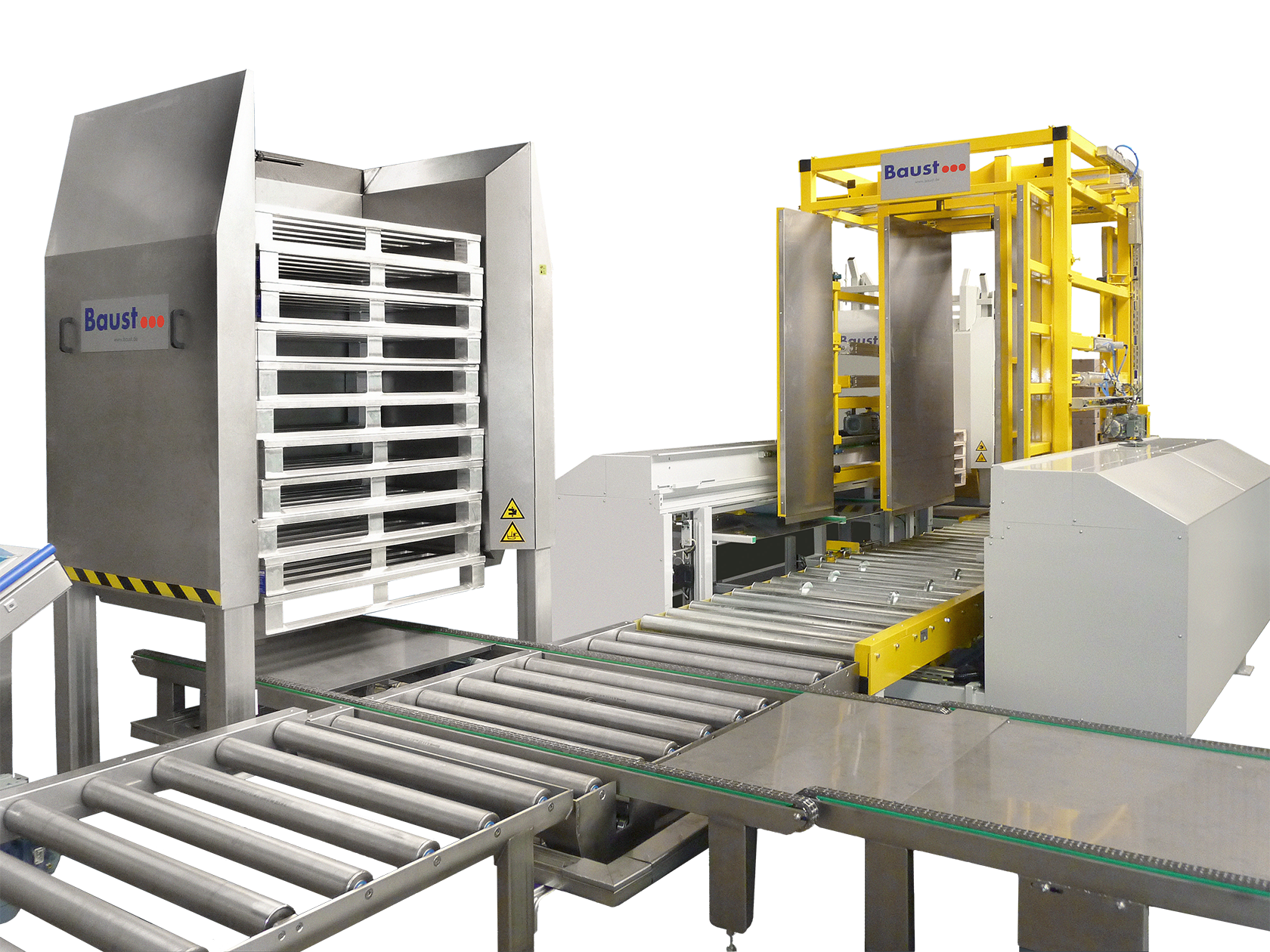
High throughput, changing product ranges, and seasonal peaks place special demands on material flow in e-commerce warehouses. One aspect is often underestimated: the efficient transfer of load carriers between goods receipt, storage, and shipping.
Why pallet changers are becoming indispensable in e-commerce
Pallet changers are becoming increasingly important in e-commerce as the demands on speed and flexibility in fulfillment centers continue to rise. Baust Pallet Handling GmbH has been helping companies optimize their material flow for over six decades and is familiar with the special requirements of online retail. Between goods receipt and dispatch, load carriers often have to be changed, whether for hygiene reasons, due to different pallet formats, or for integration into automated storage systems. This article shows where pallet changers are used in fulfillment, which processes are suitable for e-commerce warehouses, and what you should look for when making your selection.
Why pallet changers are becoming increasingly important in e-commerce
Growing shipment volumes and increasing requirements
Online retail continues to grow, and with it the number of pallets moved daily in warehouses and distribution centers. In addition to traditional B2C business, B2B online retail is also gaining volume. Orders received today should be with the customer tomorrow. This time pressure has a direct impact on every step of the process in the warehouse, including repalletizing.
At the same time, quality and traceability requirements are increasing. Incorrect load carriers, damaged pallets, or manual errors during repalletizing cost time and money. In an environment geared toward efficiency, such friction losses quickly become a problem.
Pallets as the backbone of fulfillment logistics
Despite the increase in container and single-item picking, the pallet remains a central load carrier in e-commerce. Deliveries arrive at the goods receiving department on Euro pallets, industrial pallets, or disposable pallets. Other formats are often required for internal storage and conveyor technology. And in shipping, there are specific requirements for pallet size, weight, and condition. A pallet changer in e-commerce closes this gap between the different process stages.
Where pallet changing takes place in the fulfillment center
Goods receipt and goods receipt inspection
The most common place for pallet changers in e-commerce warehouses is the goods receipt area. Suppliers usually deliver their goods on wooden or disposable pallets. However, standardized plastic or metal pallets are required for storage in automated high-bay warehouses or on conveyor lines. Without automated pallet changing, the goods must be restacked manually, which ties up personnel, causes errors, and slows down throughput.
A pallet changer in the goods receiving area takes care of this step automatically. The goods are fed in on the supplier’s pallet, the changeover to the internal load carrier takes just a few seconds, and the original pallet is automatically ejected. This prevents bottlenecks in the goods receiving area.
Goods issue and shipping preparation
Pallet changing also takes place in goods dispatch. Before shipping, internal load carriers must be exchanged for pallets suitable for shipping. Depending on the recipient and shipping route, Euro pallets, display pallets, or half pallets are used. In addition, some e-commerce companies use the pallet changer as part of cross-docking when goods flow directly from goods receipt to shipping without intermediate storage.
Typical challenges in pallet handling in online retail
Changing load carriers and pallet formats
E-commerce warehouses process a wide range of products on a variety of load carriers. Euro pallets, industrial pallets, half pallets, display pallets, and plastic pallets are used interchangeably. In addition, there are disposable pallets from international suppliers that do not meet European standard dimensions or the quality requirements of internal conveyor technology. A pallet changer in e-commerce must be able to handle this diversity.
Not only do the pallet formats vary, but so do the loads themselves. Electronics, textiles, food, household goods, and cosmetics each have different requirements in terms of product protection and handling. A system that only masters one process quickly reaches its limits here.
Seasonal peaks and the need for flexibility
Black Friday, Cyber Monday, the Christmas season, and seasonal sales promotions multiply throughput in e-commerce warehouses for limited periods of time. What is normally 500 pallets per day can become 2,000 or more during the peak season.
Manual repalletizing becomes a bottleneck during these phases, slowing down the entire material flow. An automated pallet changer handles these peaks without the need to hire and train additional staff.
Which methods are suitable for e-commerce warehouses?
Push-over method for maximum throughput
With up to 60 changes per hour, the transfer method achieves the highest throughput among pallet changer methods. Since the load is pushed horizontally from the source pallet to the target pallet, there is no stress from tilting, turning, or clamping. The transfer method is the preferred solution for e-commerce warehouses with high cycle times and sensitive goods.

This process is particularly useful for incoming goods with mixed assortments. Cartons containing electronics, cosmetics packaging, or food containers are repalletized with equal care. The space-saving design also fits into the often cramped hall spaces of fulfillment centers.
Hybrid pallet changers for changing assortments
E-commerce companies that serve different product groups from a single warehouse benefit from a hybrid pallet changer. This combines several processes in one machine and automatically adapts to the respective load. Dimensionally stable cardboard boxes are repalletized using a clamping process, while sensitive goods are repalletized using a transfer process. The changeover is controlled electronically, without mechanical conversion and without downtime. This means that one system can cover the entire product range.
Automation and integration into existing conveyor lines
Inline pallet changers in the conveyor line
For e-commerce warehouses with continuous material flow, inline pallet changers that are integrated directly into the conveyor line are ideal. The pallet is fed in, automatically changed, and transported further without the need for a forklift or manual intervention. This speeds up the process and reduces the risk of errors. In combination with complete systems consisting of conveyor technology, pallet changers, and pallet magazines, a continuous line is created from goods receipt to storage.
PLC control and connection to warehouse management systems
Modern pallet changers work with PLC control, which can be connected to higher-level warehouse management systems via interfaces. The WMS recognizes which load carrier is being fed in and specifies the appropriate procedure and target format to the pallet changer. In this way, pallet changing is integrated into the overall automated process. Status messages, error signals, and performance data are transmitted to the warehouse management system in real time, which greatly simplifies process control and error analysis.
Omnichannel logistics and the pallet changer
Serving B2B and B2C from a single warehouse
More and more e-commerce companies are relying on omnichannel strategies. End customers, marketplaces such as Amazon, and brick-and-mortar retailers are supplied from a central warehouse. Each sales channel has its own requirements for load carriers. B2C shipments leave the warehouse on shipping pallets, B2B deliveries on Euro pallets, and store deliveries on display pallets or roll containers.
A flexible pallet changer in e-commerce serves all channels without the need to set up a separate palletizing station for each shipping route. The palletizers complement the process where goods not only have to be repalletized, but also rebuilt on the load carrier.
Display pallets and store delivery
Display pallets are playing an increasingly important role in store delivery. The manufacturer or distributor assembles the goods ready for sale on a display pallet, which is pushed directly onto the shelf in the store. Pallet changers with a transfer process are particularly well suited for this repalletizing to the smaller display format. The goods are gently transferred to the new load carrier and are immediately ready for shipment.
What to look for when making your selection
Throughput, space requirements, and load diversity
Selecting the right pallet changer for your e-commerce warehouse depends on several factors. Before investing, clarify the following points:
- How many pallet changes per hour and per day are required?
- What pallet formats are used in goods receipt and goods issue?
- How diverse are the loads (dimensionally stable, sensitive, mixed)?
- How much hall space is available for the pallet changer?
- Is inline integration into existing conveyor technology required?
These points determine whether a stationary pallet changer is sufficient or whether an inline solution with automatic process switching is necessary. In e-commerce, the basic rule is: plan for growth and peak times, not just for the current average.
Future-proofing and modular expansion
E-commerce companies often grow faster than planned. A pallet changer should therefore be modularly expandable. Additional feeders, a second changeover station, or the retrofitting of an additional process should be possible without a complete replacement. We offer modular systems that grow with your business. If you are unsure which configuration suits your requirements, take advantage of our free initial consultation for a joint analysis of your material flow.
Frequently asked questions about pallet changers in e-commerce
Is a pallet changer also worthwhile for smaller online retailers?
Yes, a pallet changer can also be worthwhile for smaller e-commerce companies. Stationary models with clamping mechanisms offer an economical entry point and pay for themselves even with moderate quantities through savings in personnel and a reduction in handling errors. The decisive factor is not the size of the company, but the daily pallet handling volume.
How quickly does the investment pay for itself?
The payback period depends on the potential savings. Relevant factors include the number of daily pallet changes, the man-hours saved, and the reduction in product damage caused by manual handling. In many e-commerce warehouses with medium to high throughput, the payback period ranges from a few months to less than two years.
Which pallet formats can be changed?
Pallet changers process all common formats. These include Euro pallets (1200 x 800 mm), industrial pallets (1200 x 1000 mm), half pallets (600 x 800 mm), display pallets (400 x 600 mm), and plastic and metal pallets. Special formats can also be covered by individual adjustments.
Conclusion
The pallet changer in e-commerce is not a niche product, but a central component for efficient material flow. Growing shipment volumes, changing load carriers, and seasonal peaks make manual repalletizing increasingly uneconomical. With the right process and well-thought-out integration into your conveyor technology, you can optimize throughput from goods receipt to shipping. We support you in finding the right solution for your fulfillment center, from analysis and planning to commissioning.